
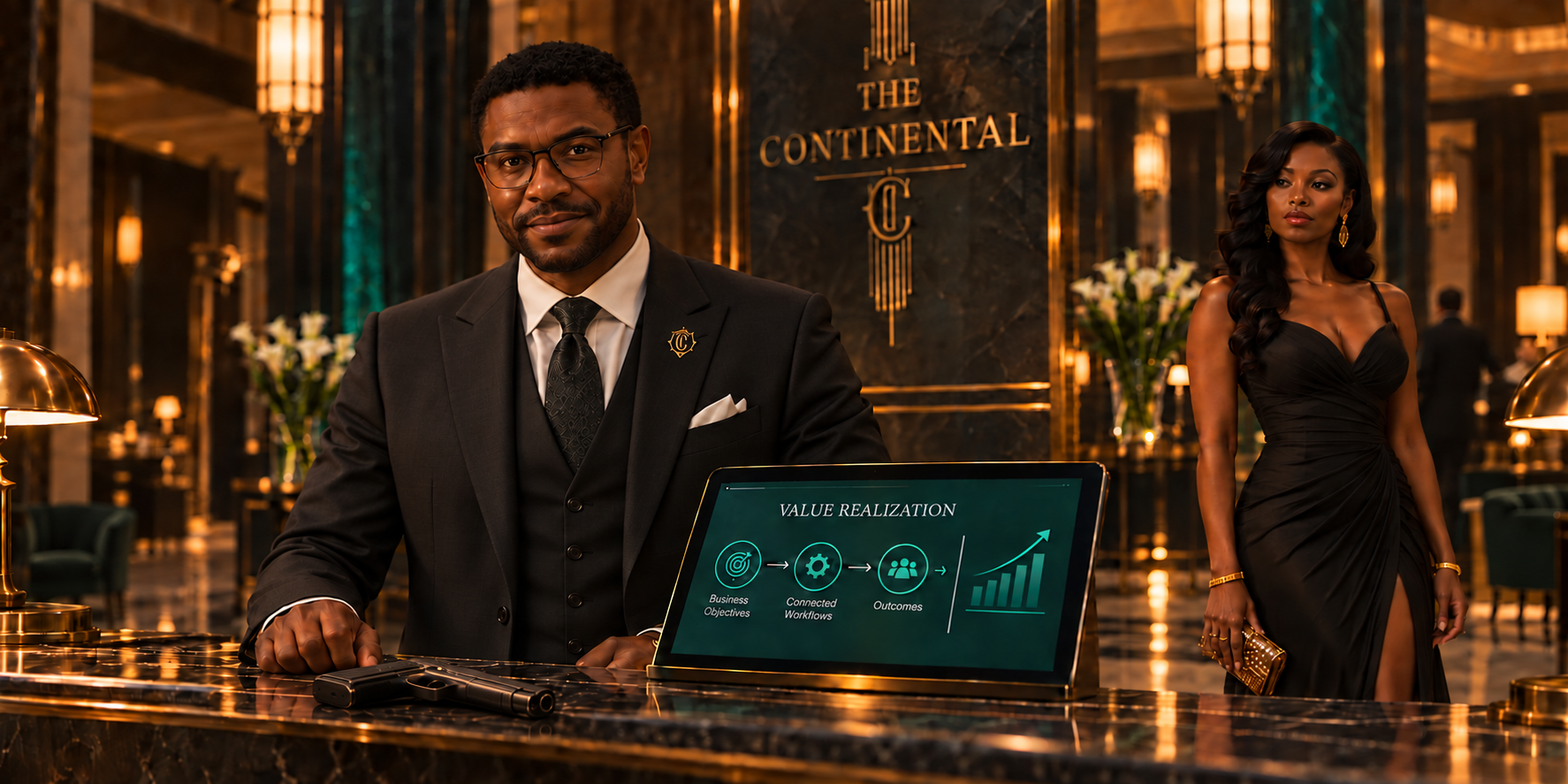
What John Wick Can Teach ServiceNow Executives About Platform Governance and Value Realization
In the John Wick films, the Continental runs on rules. Break them and the consequences reach well beyond the Continental hotel
An enterprise ServiceNow environment works on a less dramatic version of the same principles: every customization, integration, exception, and decision about ownership affects what the platform costs to run and how reliably it serves the business.
When technical debt grows, executives may ask whether to modernize the current instance or start again. The answer requires more than a list of defects. Leaders need to know which problems come from technology, which come from the way it is governed, and how much measurable economic value is being lost and can be realistically recovered.
Before issuing a contract identify the target
A contract in the John Wick universe results in a “hit”, meaning someone has identified a target. A price/value is established. The contract goes out, and the target is now in an assassin’s sight
In platform strategy, the equivalent is a decision to replace an existing ServiceNow environment with a new implementation. A clean build can be warranted when the current architecture and design cannot meet essential requirements at an acceptable cost or risk. It also brings migration expense, disruption, and the challenge of rebuilding integrations, data, and workflows.
Imagine an enterprise whose ServiceNow platform has accumulated years of custom code, inconsistent data, and a high frequency of enhancement releases. A new instance looks attractive. Yet if teams still lack clear ownership, architectural standards, and release controls, many of the same problems will follow them. The strategy must distinguish what needs to be rebuilt from what needs to be managed differently.
That is the first executive decision: define the actual target before approving a replacement program. Evaluate the cost, risk, timing, and expected outcome of targeted modernization alongside those of a new implementation. Retain customizations that serve a real need, and redesign or retire one whose cost now exceeds its value.
Put decisions before the “High Table”
The High Table is the governing authority over the larger system in John Wick’s world.
ServiceNow platforms also need a clear place for governance that crosses business units or requires funding. Although preferably with fewer duels. This metaphor is useful if it leads to defined authority rather than another meeting.
For the platform, executives need a small, practical governing body with clear authority over funding and priorities — one that decides major tradeoffs and is supported by specialists who track whether promised economic value is actually recovered.
Those in the platform and architecture leadership roles set build standards and review exceptions. Process and data owners maintain the workflows and information on which the platform depends. Business owners are accountable for the targeted economic outcomes, including establishing forecast benefits, validating results, and explaining gaps between expected and realized value.
These roles do different work. Clear decision rights let each group move quickly within agreed standards and bring consequential tradeoffs to the right leaders.
Give every value claim a “Marker”
In the films, a Marker records an obligation.
For a ServiceNow platform investment, the marker is the evidence behind a forecast of recoverable value. For ServiceNow leaders, value realization needs its own version of the Marker (i.e., a traceable record of every material value forecast). Every material economic value forecast a traceable record is created that is stored in a ledger of markers. For example, the ledger identifies baseline value achieved and leakage, assumptions, confidence level, measurement period, and business owner responsible for verifying the result.
Consider a purely illustrative Service Request process with 100,000 requests a year. If avoidable manual work adds eight minutes per transaction and the loaded labor rate is $50 an hour, the theoretical annual effort is about $667,000. If only half of that work can realistically be automated, the addressable opportunity is about $333,000. Even that is an estimate of recovered value. It becomes cash savings only if spending falls, otherwise, the benefit may be faster service or staff time redirected to other work.
This is where platform governance becomes measurable economic value realization. The question is no longer simply whether a project was delivered, an upgrade completed, or a workflow automated. The question is whether the business outcome used to justify the investment was achieved. And, if not, why.
When this level of discipline is applied, an assigned value realization team becomes accountable for every Marker, by tracking and reporting whether forecast value was actually realized and, when it falls short, determining why. Material results, gaps, and barriers then roll up to the ServiceNow platform “High Table,” where funding and strategic decisions are made based on evidence rather than platform anecdotes.
In John Wick’s world, the assigned value realization team don't issue contracts. They confirm whether the contract was completed, and whether anybody collected the bounty.
Make decisions with evidence
Throughout the John Wick films it is often said: “Rules separate us from the animals.”
Governance exists so everyone understands the rules and consequences.
This ultimately brings us back to the original strategic question. Should the company issue a contract on the existing ServiceNow platform, take it out, and start over?
A new ServiceNow implementation can absolutely be the right strategy under the right circumstances. But it should be an evidence-based High Table decision, not an emotional response to accumulated technical debt.
Because rebuilding technology without evidence-based economic value clarity will simply recreate the same problems on a newer platform.
Before making the contract decision, executives must answer four questions:
What must improve, and what measurable economic baseline will demonstrate improvement?
Which constraints are inherent in the technology, and which result from governance or operating practices?
What will it cost and how long will it take to repair, modernize, replace, or migrate the affected capabilities?
Who owns the expected business outcome, and who will verify that the economic value was actually realized?
If the current platform can meet the business need through targeted changes, the High Table can fund those changes in a sequence tied to measurable and targeted economic value. If a new implementation offers a stronger case, the same evidence should define what migrates, what retires, and which governance practices must be established first.
At the ServiceNow Continental, breaking a rule has consequences. In the ServiceNow platform ecosystem, so does paying to solve the wrong problems. Before putting a contract on the platform, identify the real target and require evidence that the proposed investment will deliver the promised value.
No platform needs to be declared “Excommunicado” simply because it has years of history.
Join the conversation
Share a question, experience, or perspective on this article.